100 Common English Sentences Used Daily (Taken from Real Vlogs)
Quick answer
The English sentences people use every day are short and flexible: greetings like "How's it going?", reactions like "No way.", replies like "That makes sense.", ordering lines like "Can I get a bowl, please?" and polite phrases like "No problem." Below are 100 of them in 10 everyday situations. Each one appears word for word in a real vlog from TalkMorrow's library of 254 videos and 13,766 subtitle lines, with a note on when to use it.
Most "100 daily English sentences" lists are written by someone sitting at a desk. You end up memorizing lines like "I am fine, thank you, and you?" that nobody actually says.
We took a different route. TalkMorrow's library has 254 real vlogs and 13,766 subtitle lines: people cooking, shopping, travelling, chatting with friends and talking to the camera. We pulled out the short sentences that come up again and again, kept the ones you can reuse anywhere, and grouped them by situation. Every sentence below appears word for word in a real video, so you can hear exactly how it's said: the speed, the stress and the little sounds around it.
How to use this list
Don't try to memorize all 100 at once. Pick one group a day and:
- Read the ten sentences and the notes out loud.
- Open one of the lessons linked under the group and listen for the sentences in context.
- Shadow them: play the line, pause, and say it with the same rhythm and tone.
- Use two of them in real life or in a message before the day ends.
Ten days later you'll have all 100, and more importantly, you'll have heard each one in a real situation.
1. Greetings and starting a conversation
The first line sets the tone. Notice how short these are: nobody in a vlog says "Good morning, how do you do?"
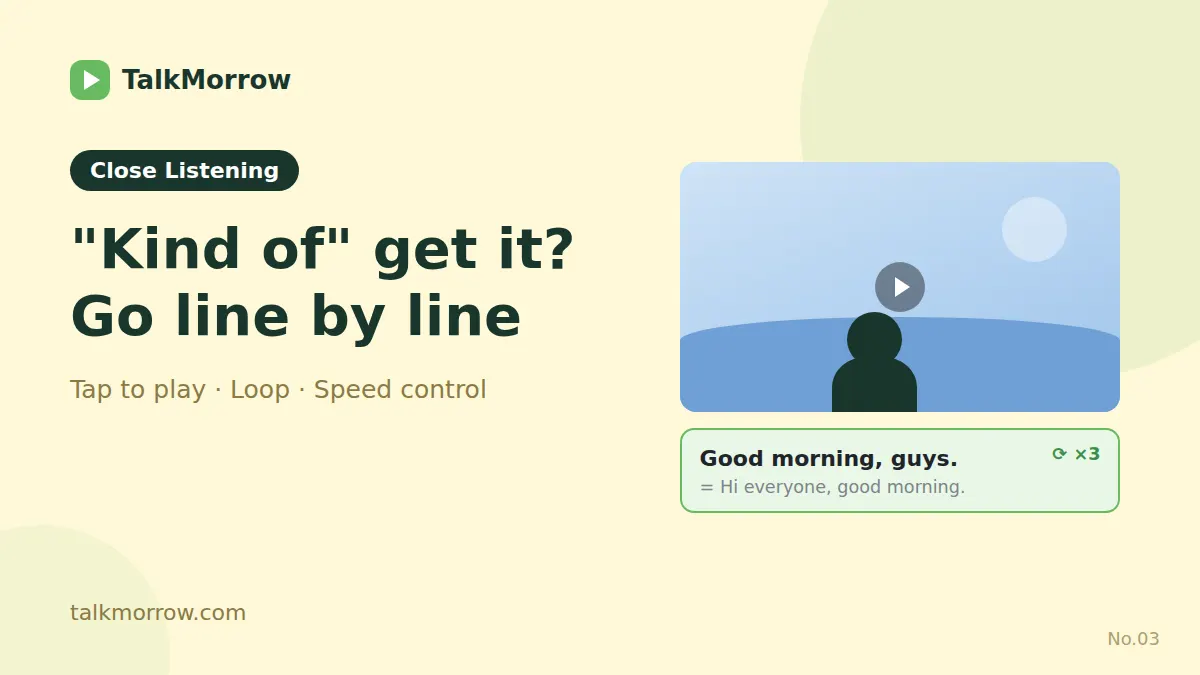
- 1. Good morning. The default morning greeting, to a person or to the camera.
- 2. Hi, how are you? Friendly and neutral. It's a greeting more than a real question.
- 3. Good, how are you? The natural reply: answer in one word, then bounce the question back.
- 4. How's it going? Casual version of "How are you?" Reply with "Pretty good" or "Not bad."
- 5. What's up? Very casual. "Not much" is a perfectly normal answer.
- 6. Hello, how are you doing? A little warmer and slower than "How are you?"
- 7. Hey, everybody. How you greet a group, or open a video, a call or a toast.
- 8. Hi there. Friendly when you don't know the person's name.
- 9. Hi, what's your name? Direct but polite when you meet someone new.
- 10. How about you? The easiest way to keep a conversation going after you answer.
Hear them in real context: A Day in the English Countryside, Ordering at McDonald's, Getting a Table at a Restaurant.
2. Reacting to what you see and hear
Reactions are where textbook English sounds most stiff. These are what people actually say in the moment.
- 11. Look at that. Pointing something out. Stress "that."
- 12. Oh my gosh. Surprise or excitement, a softer "Oh my God."
- 13. No way. Disbelief, usually happy: "I can't believe it!"
- 14. Are you kidding me? Strong surprise, good or bad, depending on your tone.
- 15. That's incredible. Big praise. "Amazing" and "unbelievable" work the same way.
- 16. That's crazy. Something surprising or hard to believe. Not about mental health here.
- 17. This is so good. The go-to line when you taste or try something you like.
- 18. Oh, really? Shows interest and invites the other person to say more.
- 19. Oh, no. Small disappointment or sympathy. Drop your voice at the end.
- 20. What a gorgeous place. "What a + adjective + noun" is a great pattern for compliments.
Hear them in real context: Today's Outfit Review, Eileen Gu: How to Keep a Champion's Mindset, Supermarket English: Real Shopping Expressions.
3. Agreeing, disagreeing and thinking out loud
These keep you in the conversation while you work out what you want to say.
- 21. I think so. A soft "yes" when you're fairly sure.
- 22. I agree with you. Clear agreement. Add "totally" or "completely" for emphasis.
- 23. That makes sense. "I understand and I accept your reason."
- 24. Fair enough. Accepting someone's point, even if it isn't what you hoped.
- 25. Same here. "Me too." Works for feelings, plans and experiences.
- 26. Yeah, totally. Enthusiastic agreement in casual speech.
- 27. Not really. A polite, soft "no."
- 28. I don't know. The most common line in the whole list. Often said fast, like "I dunno."
- 29. I don't know about you. Introduces your own opinion while inviting theirs.
- 30. I think I'm still figuring that out. Honest and natural when you don't have an answer yet.
Hear them in real context: Eileen Gu on the Jay Shetty Podcast, Natural English: Innit, Rapid-Fire Q&A: A Day in Zendaya's Life.
4. Food, cafés and eating out
Ordering is where learners freeze most. Notice how often native speakers use "Can I get…" and "Can I do…".
- 31. Are you hungry? Simple, and a common way to suggest eating.
- 32. Let's get some lunch. Suggesting a meal. Swap in breakfast, dinner or coffee.
- 33. Hi, what can I get for you? What staff say when you reach the counter.
- 34. Can I get a bowl, please? "Can I get…, please?" is the standard way to order in American English.
- 35. Can I do sour cream on the side? "Can I do…" is casual ordering for options and changes.
- 36. No beans, please. Leave things out with "No…, please."
- 37. How does it taste? Asking someone's opinion of food.
- 38. It smells so good. Use "smells," "looks" and "tastes" + adjective.
- 39. Looks delicious. The subject is dropped. That's normal in speech.
- 40. It's my treat. "I'm paying." A friendly way to offer.
Hear them in real context: Supermarket English: Real Shopping Expressions, What Traveling Alone Means, Grocery Shopping: All the Shopping English You Need.
5. Shopping and paying
Short, practical lines you'll need at any checkout.
- 41. How much was that? Asking the price after you've bought or ordered.
- 42. That's pretty expensive. "Pretty" here means "quite." It softens the complaint.
- 43. That's a bargain. A great price.
- 44. They're on sale. Reduced in price.
- 45. What size? You'll hear this for coffee, clothes and shoes.
- 46. Do you need a receipt? A cashier's question. "No, I'm good, thanks" is a natural reply.
- 47. You tap your card to pay. Explaining contactless payment.
- 48. Sorry, what's my total again? "Again" makes it polite to ask someone to repeat.
- 49. Anything else? Staff checking if you want more. "That's it, thanks."
- 50. Time to pay. A light way to say you're heading to the checkout.
Hear them in real context: Trying Breakfast in Shanghai, A Beach Day: All the Beach English You Need, Supermarket English: Real Shopping Expressions.
6. Making plans and getting moving
"Let's" is everywhere in vlogs. It turns any action into an invitation.
- 51. Let's go. The most common way to start moving, or to cheer someone on.
- 52. Let's do it. Enthusiastic agreement to a plan.
- 53. Let's get started. Beginning a task, class or meeting.
- 54. Let's go check it out. "Check it out" means "have a look."
- 55. Let's head inside. "Head" means "go" toward a place.
- 56. Let's give this a go. British-flavored "Let's try this."
- 57. Let's split it. Share the bill, or share the food.
- 58. I need to get going. Politely saying you have to leave.
- 59. I'm gonna go to sleep. "Gonna" is how "going to" sounds in fast speech.
- 60. I'm off to the loo. British for "I'm going to the bathroom."
Hear them in real context: London's Viral Banana Pudding, Rapid-Fire Q&A: A Day in Zendaya's Life, Grocery Shopping: All the Shopping English You Need.
7. Talking about how you feel
Feelings make small talk human. Most of these follow "I'm + adjective" or "I feel like…".
- 61. I'm excited. Looking forward to something.
- 62. I'm obsessed. Casual for "I love this so much."
- 63. I love that. Warm agreement with an idea, not only with things.
- 64. I'm kind of bored. "Kind of" softens the feeling.
- 65. Now, I'm hungry. Often said after seeing or smelling food.
- 66. I'm feeling refreshed. After sleep, a shower, a walk or a drink.
- 67. I feel like a kid again. Pure fun or nostalgia.
- 68. I'm so happy to be here. Polite and sincere when you arrive somewhere.
- 69. I feel like I learned so much. "I feel like" introduces an impression or opinion.
- 70. Oh, I'm out of breath. After running, climbing stairs or laughing hard.
Hear them in real context: A Day in the English Countryside, An Amazing Matcha Latte!, Eileen Gu: Direction Matters More Than Effort.
8. Asking, checking and keeping the conversation going
Short questions are powerful. They show you're listening and buy you time.
- 71. Excuse me? With rising intonation, it means "Sorry, what did you say?"
- 72. Say that again. Direct but friendly between people who know each other.
- 73. In what way? Asking someone to explain more.
- 74. What's this? Pointing at something you don't know.
- 75. Are you ready? Checking before you start.
- 76. Got it? Checking someone understood. Reply "Got it."
- 77. You know what? Introduces a new idea or decision.
- 78. Why not? "Sure, let's do it," or a real question, depending on tone.
- 79. Is it too late? Useful for plans and for life decisions.
- 80. Can I be honest? Prepares the listener for your real opinion.
Hear them in real context: Uniqlo: A Tech Company Disguised as Basics, Eileen Gu: How to Keep a Champion's Mindset, Jennie: The Power of Meditation and Focus.
9. Thanks, apologies and polite replies
These are tiny but you'll use them all day.
- 81. Thank you so much. Warmer than "Thank you."
- 82. No problem. Casual reply to thanks.
- 83. You're welcome. Standard reply to thanks.
- 84. Of course. "Sure," or a warm reply to "Thank you."
- 85. Here you go. Handing something to someone.
- 86. There you go. Handing something over, or "You did it right."
- 87. Excuse me. Getting past someone or getting their attention.
- 88. My pleasure. A warm, slightly formal reply to thanks.
- 89. Sure, absolutely. A strong, friendly yes to a request.
- 90. Sorry to leave you hanging. Apologizing for a late reply or a long wait.
Hear them in real context: Grocery Shopping: All the Shopping English You Need, Jeff from Google on Productivity: Managing a Day Job and a Side Hustle, A Real Ordering Conversation.
10. Wrapping up and saying goodbye
Endings are easy to get wrong. These sound natural in person and on the phone.
- 91. Okay, bye. The simplest goodbye.
- 92. See ya. Very casual "See you."
- 93. See you soon. When you'll meet again soon.
- 94. See you in a bit. "See you in a little while."
- 95. Take care. Warm goodbye, also used at the end of messages.
- 96. Have a good day. Polite goodbye in shops, offices and calls.
- 97. I'll see you later. Goodbye when you'll meet again the same day or soon.
- 98. Thanks for joining me today. Ending a call, class or video.
- 99. Let me know in the comments. Vlogger English, also handy in group chats: "Let me know."
- 100. Cheers, guys. British "Thanks" or "Bye," said to friends.
Hear them in real context: My Full Self-Care Routine, Restocked!, What No One Tells You About Your 20s, Learn English on a London Tour with Jay.
From reading a list to saying it naturally
A list gets you the words. Saying them naturally takes three more things:
Hear the rhythm. "I don't know" is usually closer to "I dunno." "Let's go" is one quick beat. "Are you kidding me?" rises sharply at the end. You only pick this up by listening to real people, which is why each group links to the lessons the sentences come from.
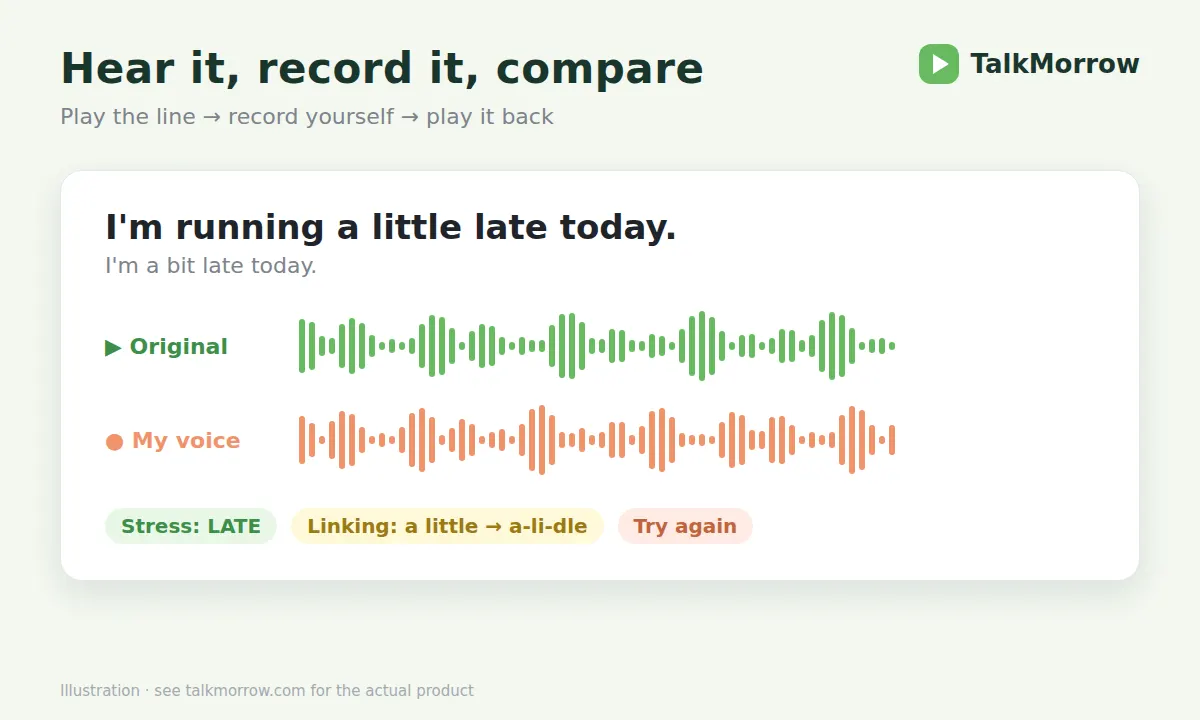
Copy it out loud. Shadowing means repeating a line right after the speaker, matching their speed and melody. On TalkMorrow you can loop a single sentence, record yourself, and play your take right after the original. It feels awkward the first time, and it's the fastest way to hear the gap. Our shadowing guide walks through it step by step.
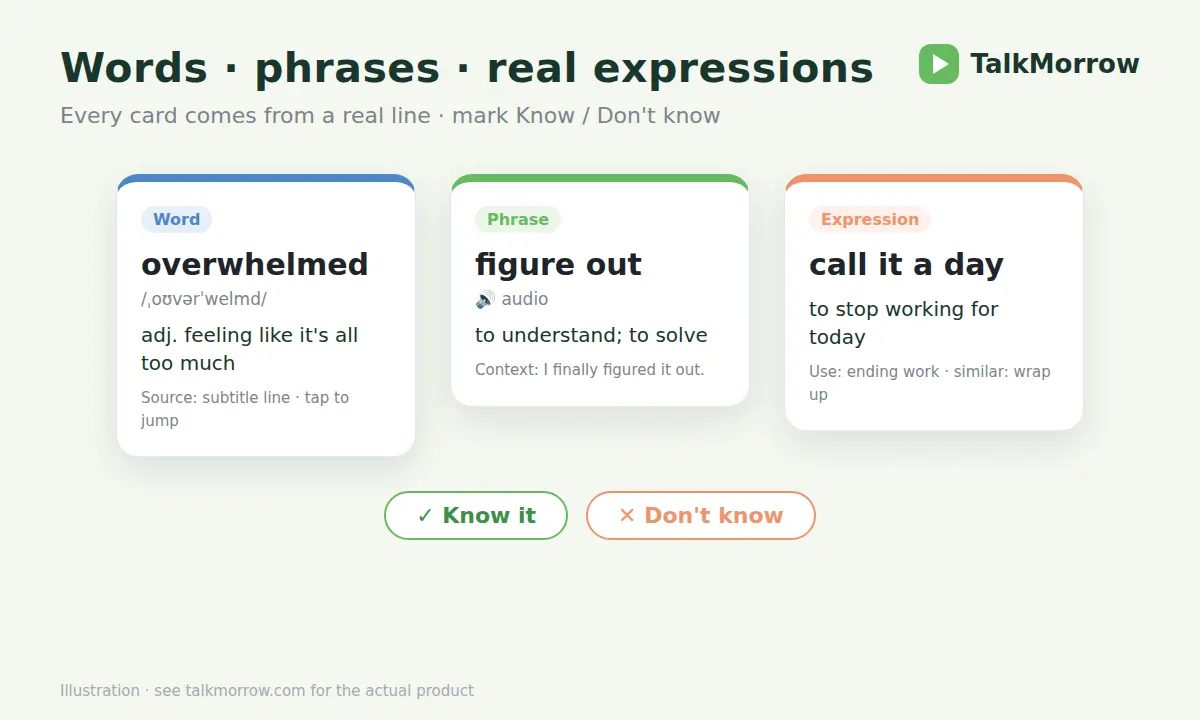
Review before you forget. Save the sentences you want to keep as cards. Short daily reviews beat one long cram session.
Why real sentences beat textbook ones
Notice what's missing from this list: "How do you do?", "I am fine, thank you" and "Goodbye, see you tomorrow" in full. Real spoken English is shorter, drops words ("Looks delicious."), and leans on a handful of flexible patterns: "Let's…", "Can I get…", "I feel like…", "What a…!". Learn the patterns and you can make hundreds of new sentences from these 100.
FAQ
What are the most common English sentences used daily?
Short, reusable lines: "Good morning.", "How's it going?", "I don't know.", "That makes sense.", "Let's go.", "Can I get…, please?", "Thank you so much." and "See you soon." The 100 above are grouped by situation so you can learn the ones you need first.
Where do these sentences come from?
From the subtitles of the real vlogs in TalkMorrow's lesson library: 254 videos and 13,766 subtitle lines. We kept short sentences that appear in everyday situations and checked that each one appears word for word in at least one video. Each group links to lessons where you can hear them.
Are these sentences American or British English?
Mostly neutral: you'll hear them in both. A few are clearly British and marked as such, like "I'm off to the loo.", "Let's give this a go." and "Cheers, guys."
How long does it take to learn 100 English sentences?
About ten days if you take one group of ten a day, read them out loud, listen for them in a lesson and shadow them. What matters more than speed is hearing each sentence in context and using a couple of them for real.
Is there a PDF of this list?
Not at the moment. You can print this page, and every TalkMorrow lesson can export its full subtitles as a text file if you want the sentences in their original context.